UX Design with Chloé Temesvári
Pursuing your passion in spite of self-doubt

UX Design, what’s that?
According to Chloé Temesvári, there are as many definitions of UX Design as there are UX designers. Summing up this emerging field in just a few sentences is no easy task, but here is one workable definition.
UX Design, or User Experience Design, involves creating digital interfaces designed first and foremost around users’ needs and expectations. Behind every intuitive website or user-friendly app lies a significant amount of careful thinking. Before a single button is drawn, the process begins much earlier: qualitative research, shadowing, field immersion…a range of methods used to identify and address real, concrete problems.
For Chloé Temesvári, a good interface is not simply something visually appealing or modern. It is, above all, about understanding the habits, behaviours, and expectations of the people who will use the final product. Designing an interface is a bit like putting together a puzzle: every detail matters, because every element must guide the user naturally, without them ever really having to think about it.
An ever-changing day-to-day
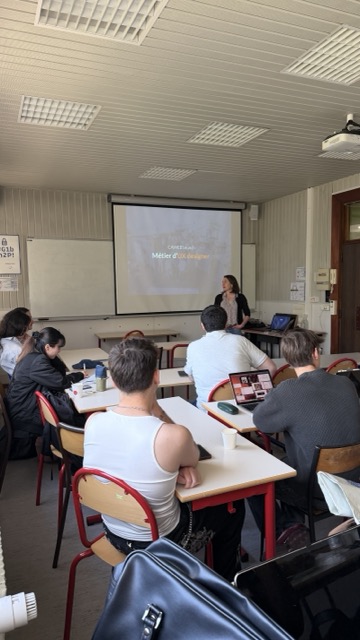
What makes the UX designer’s job so rich is precisely its diversity. Combining user research with interface design means no two days are the same, and involvement at every stage of a project. Chloé Temesvári knows this well: her career has taken her from a travel agency to a startup, as well as into teaching in both private and public education.
This diversity also reflects a broader reality in the digital sector: careers there are rarely straightforward. You have to keep learning and staying current, developing new skills because stepping out of one’s comfort zone is part of the journey.
She also encouraged us to see our technical limitations not as obstacles, but as genuine learning opportunities. Starting, experimenting, and learning despite uncertainty is often what shapes a fulfilling career.
Design is responsibility
One of the highlights of the discussion was the mention of the talk “How Design Destroys the World” by Mike Monteiro, the well-known American designer.
Through the story of Bobby Duncan, who became the unintended victim of an involuntary coming-out due to poorly configured Facebook privacy settings, Chloé Temesvári reminded us of an often overlooked reality: designing an interface is not just about creating something clickable.It is about making decisions that can have a real impact on people’s lives.An important reminder that ethics and design should never be treated as separate concerns.
Between impostor syndrome and professional uncertainty
Eventually, the conversation also turned to more personal and pressing concerns for students and young professionals: questions about salary, the role of AI in the field, and imposter syndrome, that persistent self-doubt experienced by many.
We also discussed the challenges of finding an apprenticeship and entering the job market, with the feeling of “becoming an adult at the worst possible time” thus, to navigate through adulthood clumsily and laboriously. Chloé, while acknowledging the difficult economic climate, encouraged us to rethink our relationship with our areas of expertise and to remain hopeful about the future.
In conclusion
Overall, from this CAWEB’Brunch with Chloé Temesvári, we will remember that in UX Design as in life, daring to explore new horizons and learning from every experience are the true foundations of a rewarding career along with a meaningful life.
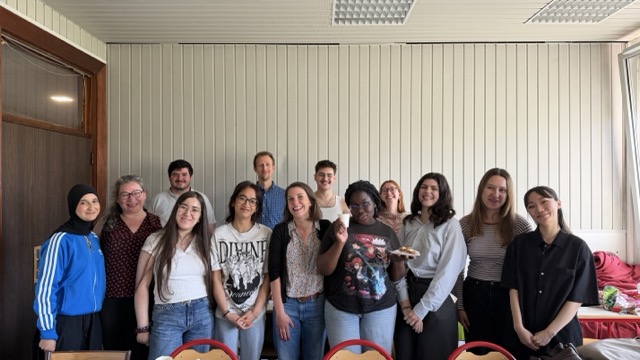
A huge thank you to all the attendees, and to Chloé Temesvári for her wonderful ability to share her knowledge and her stories.
Until next time at CAWEB’Brunch !